
Mayra Cruz, Joanne Pérodin, et al.
Mayra Cruz*, Katharine J Mach, Lynée L Turek-Hankins, Kilan C Ashad-Bishop, Zinzi D Bailey, Scotney D Evans, Ashley Fanning, Margo Fernandez-Burgos, Jane Gilbert, Bereatha Howard
Published 9 May 2025 • © 2025 The Author(s). Published by IOP Publishing Ltd
, , Citation Mayra Cruz et al 2025 Environ. Res.: Climate 4 023002DOI 10.1088/2752-5295/adc827
Abstract
Research on heat and its risks has focused on heat waves as an increasing emergency under climate change, but this emphasis has obscured the chronic—not just acute and episodic—exposure of billions of people globally to increasingly dangerous levels of heat. In many regions, predominantly in the global tropics, heat index exceeds a level of extreme caution according to the US National Weather Service (90°F, 32.2 °C) for more than an entire season and in some cases for much of the year. We propose chronic heat as an alternative framing for heat-related hazards in these regions and demonstrate how its risks differ and are incompletely captured by current heat–health research practices. Chronic heat poses unique risks compared to acute heat because the intersection of enduring societal- and individual-level factors leads to substantially divergent cumulative exposures over seasonal timeframes and associated health outcomes, quality-of-life impacts, and tradeoffs. These multiple interacting factors are difficult to tease out and attribute with traditional heat–health research practices, and therefore understanding of the impacts of chronic heat has remained poor. Further, managing chronic heat requires use of social services, programs, and partners not previously engaged in the context of heat, going beyond heat response as emergency management. Our chronic heat framework identifies a shift needed in heat research and practice to understand and address chronic and cumulative heat exposures increasingly experienced worldwide under intensifying climate change.

Original content from this work may be used under the terms of the Creative Commons Attribution 4.0 license. Any further distribution of this work must maintain attribution to the author(s) and the title of the work, journal citation and DOI.
1. Introduction
Historical approaches to defining, studying, and managing heat waves has underemphasized the risks and impacts of chronic heat throughout regions of the world. Under the World Meteorological Organization’s (WMOs) definition of heat waves, the subtropics and tropics have very few, sometimes zero, heat wave events over 1983–2016 (shown in black, figure 1), even though these regions experience dangerous heat indices across months of the year (shown in colored circles, figure 1) [1, 2]. Further, by mid-century, the subtropics and tropics are expected to face more dangerous heat index (HI) days, and new regions will be chronically exposed under intensifying climate change [3]. Perhaps counterintuitively, definitions of extreme heat in both research and practice have largely ignored exposures in the parts of the world that are dangerously hot for much of the year.
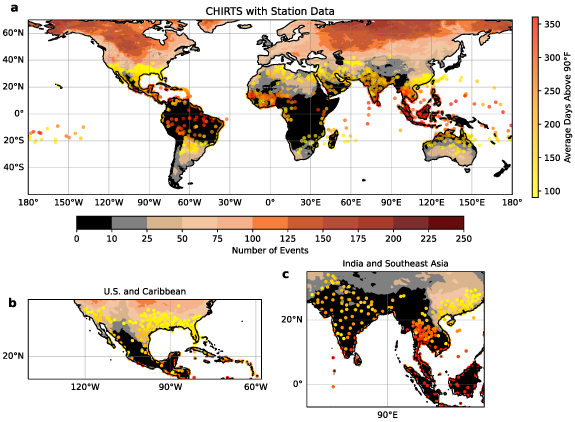
Here, we propose chronic heat as an alternative framing for heat-related hazards that is increasingly relevant to both research and practice. Chronic heat is experienced unevenly due to intersectional determinants of vulnerability such as health status, social relations, housing and living circumstances, and economic insecurity [7]. Differential risks are further compounded by variations in exposure at the hyperlocal scale due to the urban heat island (UHI) effect and the multiple residential, occupational, and individually specific settings in which exposures occur [8–11]. Increasing evidence suggests that chronic heat exposure and its cumulative heat stress can exceed limits to acclimatization [12–14], although further research is needed to understand acclimatization under chronic heat conditions especially in the tropics [15].
There are key gaps in our understanding of chronic heat risks. Thus far, studies of heat exposures indoors and outdoors and the health impacts of heat waves have largely focused on developed countries in the northern hemisphere, with much less known about tropical and subtropical regions [16–18]. Extreme health impacts are therefore better understood in temperate regions with occasional heat waves, as compared to subtropical-to-tropical regions with more than three billion people globally [19], in which chronic heat occurs for months at a time (figure 1). Although heat–health studies have established that persistent heat exposure can negatively impact physical and mental health [20–23], there is relatively little understanding about how most-vulnerable groups within and across countries may be already impacted by chronic heat exposures, including potential morbidity and quality-of-life impacts. There is understanding that chronic heat requires different approaches in research and practice [7, 12, 24], but to date, there has not been a framework for defining chronic heat as a hazard, measuring and modeling its impacts across vulnerable populations, and evaluating and implementing solutions.
In this perspective, we chart a pathway for understanding chronic heat as a different kind of climate hazard, as compared to acute heat as traditionally defined, studied, and managed. We apply principles for assessment of complex climate risk, reflecting the interacting drivers and determinants of risk from chronic heat [25]. We first consider how temporal factors differentiate chronic heat as a hazard and present a working definition (section 2). Next, we assess multiple drivers of vulnerability and exposure and how these drivers create cumulative exposure and intersectional risks (section 3). Then, we evaluate the state of adaptive responses and provide recommendations to alter responses to better address systematic inequalities across known spaces of heat exposure (section 4). Finally, we suggest approaches for tackling the substantial crosscutting knowledge gaps surrounding chronic heat risks and responses (section 5). Throughout, we draw from examples at local, national, and global scales and advance understanding of the complex risks from chronic heat [25]. Our framework for understanding chronic heat risks challenges existing research and practice to evolve towards a knowledge and decision-making paradigm in which heat events are no longer just brief shocks and emergencies to manage, but instead chronic stressors that mirror and reveal profound inequities in societies and require new and ongoing approaches for effective, just adaptation.
2. Chronic heat hazards differ from heat extremes
Chronic heat is typified by elevated average temperatures on seasonal scales often defying the absolute and relative thresholds used to define heat waves. The duration and intensity of heat on longer time frames can create hazardous conditions missed in thresholds focused on transient deviations and extremes. Historical definitions for heat waves focus on either relative thresholds near the upper tail of a temperature distribution—that is, conditions hotter and/or more humid than average summer temperatures at a daily time scale—or absolute thresholds set at daily maximum temperatures (figure 2) [6, 26–28]. These definitions can vary according to local context and preferences, leading to multiple definitions and terms to describe heat waves and acute heat. Across definitions, duration of an acute heat event is typically at a daily or weekly time scale, a rare event. This approach, considering the tails of temperature distributions, misses potentially dangerous heat that occurs in locations with high temperatures that persist for months (figure 1).
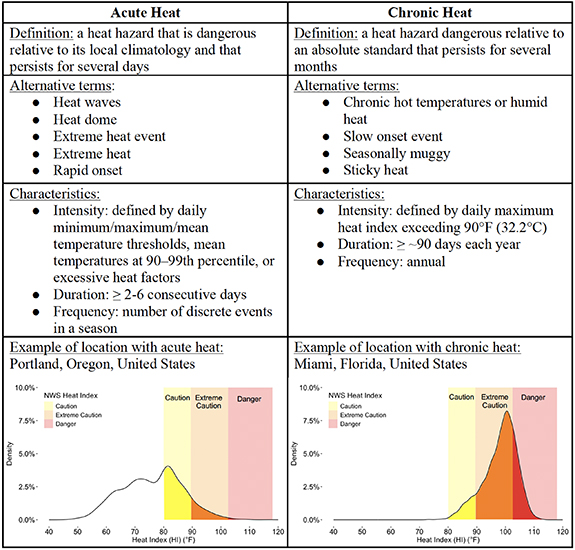
To illustrate the differences between acute versus chronic heat, through density plots we compare the HI frequencies recorded from 2000 to 2024 during the heat season (1 May–31 October) in an acute heat location, Portland, Oregon, USA, with a chronic heat location, Miami, Florida, USA (figure 2). Most heat indices recorded for Portland fall below the ‘caution’ level of the National Weather Service (NWS) HI classification, with rare spikes in the ‘danger’ category during historic heatwaves. In contrast, Miami’s heat indices are largely within the ‘extreme caution’ threshold and often above the 104°F HI (40 °C HI) ‘danger’ threshold, showing how current definitions of extreme heat fall short of recognizing the threat posed by frequent and long-term exposure to hot temperatures. Additionally, research has shown that NWS thresholds are mismatched for certain geographies in which heat warnings occur after heat–health impacts are observed, demonstrating a need to revisit threshold criteria [29, 30].
We therefore define chronic heat in a region as a dangerous heat hazard that persists for several months out of the year. To illustrate the regions where this applies, we show locations where the daily maximum HI exceeds 90°F (32.2 °C) for more than 90 d (figures 1 and 2). A 90 d duration threshold, the equivalent of a season, differentiates cities that may occasionally reach high dry-bulb or HI levels in acute heat areas from those that are chronically exposed. In the United States, the NWS uses HI (combining both temperature and relative humidity) to issue excessive heat watches and warnings. As a basis for the threshold for chronic heat, we use the NWS HI table, which classifies 90–103HI°F (32.2–40HI °C) as ‘extreme caution,’ meaning that people in high-risk groups with prolonged exposure and/or physical activity at these levels could possibly experience sunstroke, heat cramps, or heat exhaustion [31, 32]. Note that because the HI combines temperature and humidity, chronic heat can occur in dry regions with elevated temperatures (such as the Southwest US), and humid regions where the temperature may not be excessive, but the combination with humidity makes it dangerous (such as the Southeast US) [33].
Chronic heat hazards vary at the hyperlocal scale due to geographical factors, urbanization, and the built environment, underscoring the importance of local context and knowledge for capturing impacts. Physical factors, such as the UHI effect, lead to different microclimates [10, 34] modulating heat exposures and risks. The UHI effect is strongest in cities where urban sprawl is more prominent and can intensify heat in already hot locations due to darker, non-permeable surfaces and higher concentrations of pavement trapping and absorbing heat [10, 35]. Previous studies focused on heat and microclimates have demonstrated discrepancies between NWS readings and those from experimental weather stations, mobile sensors, and citizen science efforts [8]. For example, a Miami-Dade County, Florida, study compared readings from iButton sensors to the NWS site at the Miami International Airport (MIA) and on average found that maximum temperatures are 6°F (3.3 °C) higher and maximum HI values are 11°F (6.1 °C) higher across the metropolitan region, as compared to the MIA site [8]. The study demonstrates that hyperlocal conditions can elevate heat hazards to dangerous levels, even when officially reported temperatures are lower. Local context will lead to variations within chronic heat metrics due to factors such as limited diurnal-to-seasonal ranges and the UHI effect, but more research is needed to understand these relationships in conjunction with local data on vulnerable populations.
Regardless of this hyperlocal variability—for which there may be limited data, especially about humidity—our climatological definition of heat provides a starting point for indicating places where the chronic heat hazard is fundamentally different from places where heat comes in waves. It also allows for identification of places where heat is becoming more chronic than acute as the climate warms.
3. Danger from chronic heat looks different
Chronic heat risks are fundamentally different from acute heat risks because exposure accumulates seasonally and annually, leading to impacts to health and quality of life and consequences for capacities to cope and adapt. In a typical climate change risk assessment framework, there is a tendency to evaluate risk determinants as separate hazards, vulnerabilities, and exposures, leaving out important interactions that occur across these boundaries [25]. By contrast, Simpson et al framing of complex risk, which we draw from here, reflects how, in the context of chronic heat, multiple drivers of vulnerability and exposure interact over time to create risk [25]. In the case of chronic heat, there is a cumulative interplay between vulnerability and exposure that increases risks and reduces adaptive capacities for some people and groups. A more dynamic view of risk assessment is needed to identify chronic heat risks and inform responses. Below we outline a reconceptualization of vulnerability, exposure, risk, and adaptive capacity to encompass the challenges specific to chronic rather than acute heat.
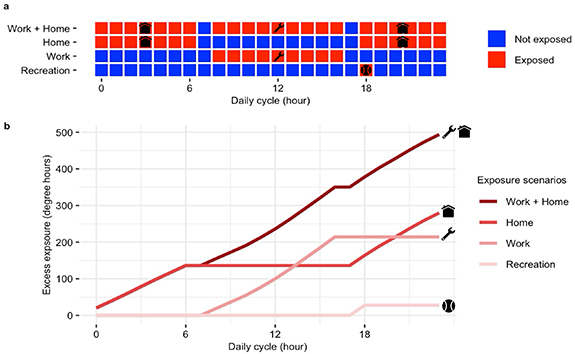
Heat exposure in chronically hot places can be omnipresent due to how individual and social vulnerabilities interact over seasonal time frames. Past heat-exposure research has established how individual factors such as age, mental and physical health, and livelihood can increase susceptibility to heat stress, in addition to societal characteristics such as housing quality, access to clean water, and/or quality healthcare (figure 3) [36–40]. These individual and societal characteristics are difficult to separate from exposure because they dictate someone’s ability to live and work in cooler, safer, and well-resourced places. Individuals can be chronically exposed to heat across different spaces, such as inside their homes or outdoors during recreation or commutes, or through their occupation (indoors or outdoors), modulated by individual and social vulnerabilities (figure 3) [41]. In combining vulnerabilities and spaces of exposure, we can see different pathways of cumulative exposures and the ways in which chronic heat risks differ from those from acute heat. For example, consider a person living in a disinvested neighborhood in an older, energy-inefficient house and working a low-wage construction job. An individual in this situation, under chronic heat, is exposed during the day and night (figure 4). By contrast, in an acute heat setting this individual is exposed for only days at a time during heat waves, then experiences relief when the heat wave dissipates. The key difference is that an individual living in a chronically hot area is experiencing an elevated level of exposure repeatedly for at least one third to one half the year without consistent periods of relief (figure 4(b)). Cumulative exposure may also be worsened by elevated nighttime temperatures [42]. The cumulative differences in exposures are profound. By understanding how individual and societal factors and vulnerabilities interact to create pathways of exposure, we are better equipped to identify chronic heat risks and intervene.
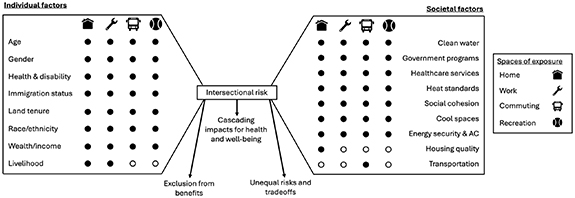
Chronic heat risks are different from acute heat risks because intersecting vulnerabilities and accumulation of heat exposure over seasonal time frames lead to divergent health outcomes and quality-of-life impacts. The associated risks have not been sufficiently documented in extreme heat research. Heat–health research has historically focused on understanding how acute heat impacts health and well-being and has established that it exacerbates multiple physiological and psychological conditions, worsens overall well-being, burdens health care systems, and leads to death [38, 42]. Less research has been conducted to understand the impacts of long-term exposures to heat (>3 months) but has demonstrated decreased kidney function from repeated heat stress and dehydration among agricultural workers who are disproportionately affected by chronic kidney disease [22, 64, 65]. This research indicates that the recurrence and persistence of chronic heat stress and heat-related symptoms is leading to morbidities that would not occur with daily or weekly heat exposure. Additionally, chronic heat stress not only is a burden on a person’s mental and physical health but also has far reaching implications for a person’s quality of life, financial security, and social connectedness—impacts that have been infrequently measured and quantified to date. Households can become chronically financially stressed from having to keep up with energy bills [40, 52], and heat-exposed workers are already facing difficult decisions around missing work for their own safety [66]. Social health impacts have been captured as well, such as reducing outdoor activities, decreasing mingling with other people, and skipping work or school [67]. Chronic heat risks are thus tied to mortality, as in much of the heat-health research, but they also have far-reaching impacts into a person’s everyday life.
The potential to cope, respond, and adapt to chronic heat is different from acute heat because households must cope for much longer periods of time rather than responding to an isolated event. These dynamics can be understood through the resilience reserve framework, which argues that marginalized groups facing ‘social, economic, medical, physical, and geographic vulnerabilities expend resilience resources to manage everyday hardships’ [40]. Unexpected or stressful life events, such as loss of income, a global pandemic, accidents, caregiving, and concurrent physical hazards like flooding or wildfire, can further destabilize a household already struggling to address everyday hardships. Managing multiple, interacting hardships leaves fewer opportunities for a household to have sufficient psychological and material means to respond to and recover from the prolonged exposure to chronic heat. For those already vulnerable, they must expend reserves that are already under stress to cope with the long-term exposure to heat [52]. Concerns arise over acclimatization and the degree to which it provides measurable protection given overwhelming physical, physiological, and social barriers [13, 14, 68]. Chronically exposed individuals (figure 3) can reach adaptation limits given the persistence of exposure and challenges with finding a different job and/or moving to a cooler yet unaffordable area. Responses to chronic heat therefore must be attuned to intersectional and compounding vulnerabilities, cumulative exposure, and lessened adaptive capacity that can result in increasing risks for some people and groups.
4. Different responses are needed for chronic heat
Chronic heat requires different responses as compared to acute heat, grounded in on-going solutions relevant to structural and social determinants of risk. Thus far, heat planning and responses have built from disaster risk and emergency management for acute heat events, meaning that responses are largely short-term in scope, reactive, and limited by rigid governing structures [69, 70]. Studies focused on heat planning globally have emphasized issuing heat warnings, communicating risks, and opening cooling centers and placed less focus on heat mitigation strategies (e.g. green roofs), social services (e.g. energy bill reduction), and targeted efforts for at-risk populations (e.g. providing transportation to cooling centers) [41, 70–74]. An emphasis on emergency management has largely ignored the needs of chronically hot places, which require solutions and governing structures addressing the root causes of chronic heat exposures and vulnerabilities that are products of long-standing systemic inequalities. Solutions also must reflect local contexts shaping risks, such as through geography, politics, culture, norms, and available resources, to avoid ‘homogenizing vulnerability,’ implementing one-size-fits-all approaches, and ignoring implementation barriers [41, 71]. Here, we propose instituting solutions to heat risk and exposure that target systemic inequalities and increase resilience within and outside homes through horizontal (i.e. between departments) and vertical (i.e. top–down) coordination.
Solutions for chronically heat-stressed individuals can be achieved by adaptive adjustments to ongoing, long-standing services, programs, and policies to encompass chronic heat. Behavioral and cultural adaptations focused on individual-level action can reduce risk (figure 5), but this problematically assumes that individuals have the resources and agency to adapt; therefore, behavioral adaptations should not be the sole focus of future solutions [7]. Rather, there may be greater potential in chronic-heat relevant modifications to technical/infrastructural, institutional, and nature-based adaptations, to reduce chronic risks. For example, infrastructural adaptations such as shading structures, drinking facilities, and temporary shelters are utilized in heat action planning [70–73], but can be more impactful by targeting spaces of exposure such as bus stops, job sites, and parks frequented by chronically vulnerable individuals (figure 5). Institutional adaptations require the most collective action and investment to address chronic heat risk but carry great potential (figure 5) [39]. Because chronic heat risks are largely tied to material hardships, such as livelihood insecurity and low-wealth/income (figure 3), existing programs such as supplemental income assistance, livelihood security for agricultural workers, and energy assistance can become foundational solutions [40, 53]. Social welfare programs, energy affordability programs, job assistance, and early screening for heat-related illnesses can take place at cooling centers while individuals cool down, thus providing immediate and long-term relief. While chronic heat requires adaptive adjustments to the status quo, the benefits from building capacity and resilience will likely help individuals weather both increasing temperatures and other hazards and shocks [53].
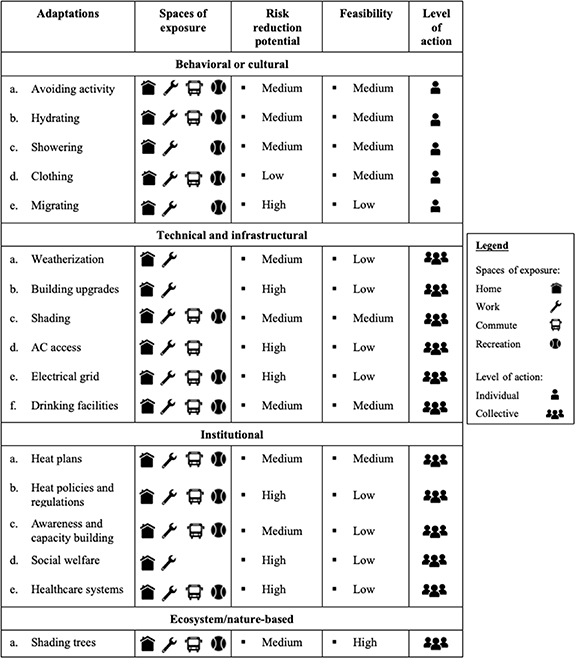
Chronic heat responses necessitate multi-level coordination and mainstreaming within and outside of government agencies. First, governments can define and include chronic heat across existing hazard mitigation plans and set mandates for agencies to prioritize chronic heat in their work. To accomplish this, a nested approach of collaborative governance can facilitate multi-level vertical coordination (e.g. national/federal, state, county, municipal). For example, India’s National Disaster Management Authority created heat management guidelines in 2016 that have been adopted by State Disaster Management Authorities as well as District Disaster Management Authorities, leading to over 40 heat action plans across jurisdictions [85]. Second, governments may identify or appoint adaptation champions such as Chief Heat Officers, standalone heat offices, and public health agencies that are well equipped to serve as leads, coordinate interagency initiatives [86–88], and minimize confusion over ownership of this work [69, 89]. Mainstreamed chronic heat responses benefit from leadership, political will, and adaptation champions [24, 87]. Third, with leadership from adaptation champions, governments can encourage various agencies (e.g. meteorological entities, urban planning, public health, parks and recreation, public works, resilience/sustainability) and outside actors (e.g. non-governmental organizations, businesses, chronically hot populations) to work together to create holistic responses [24, 86]. In many cases, emergency planning departments are solely responsible for heat response, creating silos that limit responses to emergency management rather than addressing chronic heat as an intersectional, chronic hazard [69, 70]. Instead, a weather service organization can provide data on nighttime temperatures across a city to the parks and recreation department and public health practitioners to determine where cooling centers need to stay open throughout the night. The transit department can assist in creating bus schedules that facilitate access to these centers and community organizations can assist with outreach. Lastly, non-traditional actors such as water and energy utility companies, landlords, real estate developers, and business owners must be brought in by governments and champions to create solutions that address energy and water security, housing, and employment safety. The proposed approach is not only useful for chronic heat but will help in addressing other hazards such as flooding and drought that present as acute events as well as chronic, repetitive exposures.
5. Towards a chronic heat research agenda
To further foundational understanding of chronic heat risks and potential solutions, research agendas need to prioritize data and monitoring, expansion of current practices, and interdisciplinary collaboration. Research collaborations can advance the knowledge and policy partnerships needed to make chronic heat visible, elevate its urgency in decision-making, and identify effective solutions. Below we propose pathways to advance chronic heat research agendas through six key priorities.
Data sharing: Current data practices can be improved to allow greater availability of information to understand and craft targeted solutions for chronic heat. Across country contexts, challenges exist in accessing health data due to confidentiality clauses, lack of processes that allow for ready access, and limited maintenance of datasets [90–92]. During the COVID-19 pandemic, the Research Data Alliance (RDA) crafted recommendations for improved data sharing and decision-making that are especially relevant for improving heat–health data practices [93]. For example, to preserve an individual’s privacy, RDA recommends pseudo-anonymization of direct identifiers (e.g. patient ID), anonymization of indirect identifiers (e.g. an individual’s sociodemographic information), and use of vetted trustworthy data repositories. Updating data sharing policies such as Memoranda of Understanding, data sharing agreements, and emergency data release agreements among universities, hospitals, and healthcare facilities can facilitate more timely access to data [93]. Intergovernmental organizations such as the World Health Organization already provide avenues for global sharing of data [93]. Other organizations such as the Red Cross Climate Centre and the WMO can provide pathways for coordination across governments, researchers, and smaller non-governmental organizations. Centralizing and expanding access to existing data can improve decision-making and assist in crafting effective responses.
Improved granular heat data: Future research focused on chronic heat should consider interactions across scales, climatic processes, and indoor and outdoor locations to better quantify cumulative local exposures to chronic heat experienced by vulnerable populations. Hyperlocal observations are key to understanding how heat is experienced from block to block and how UHIs are contributing to unequal exposures [8, 94, 95]. Utilizing citizen science to place sensors inside homes and outdoors is a cost-effective way to collect hyperlocal data to understand heat stress [68, 96], differences between sensor and weather station measurements [8, 94], and the mechanisms through which urban environments diminish or contribute to ambient heat [95]. Building high quality sensor networks can complement these efforts through fixed and mobile sensors to more accurately capture variations across regions [97].
Revision and expansion of existing heat metrics and thresholds: New data can be utilized to update existing heat definitions, thresholds, and triggers for weather alerts and heat response plans. Tying actions to certain thresholds, such as weather advisories and warnings initially designed for acute heat waves and events, may need to be reconsidered. Defining these thresholds is problematic in regions where a potentially dangerous level of heat persists for months at a time: it is of course possible to define a threshold for the most extreme temperature and HI days, but in chronic heat regions, a return to normal need not mean that actions should be suspended. Indeed, Hondula et al showed that while heat advisories were infrequent in the US states of Texas and Florida, heat attributable mortality was relatively high, in contrast to more temperate locations where the reverse was true [29, 30]. Instead, we suggest that climatological thresholds are used to define heat seasons rather than heat events, for which messaging, availability of cooling sites, and outreach services are seasonal, rather than only during heat advisories and warnings. The City of Phoenix, Arizona, in the US takes this approach where their heat season runs from 1 April to 30 September with heat response actions such as water distributions and outreach to unsheltered communities taking place the entire season [98].
Long-term heat–health surveillance: Heat–health surveillance currently falls short in capturing how chronic heat impacts people’s well-being. Most studies focus on mortality or hospitalizations as occur during heat waves [37], missing health outcomes and behavioral consequences from repeated and long-term exposure. The time horizons of chronic heat are better suited to longer-term epidemiologic surveillance like chronic disease surveillance to understand the development and exacerbation of diseases and morbidity. For example, a few longitudinal studies have captured that increasing indoor temperatures are associated with negative health symptoms among the elderly [99] and increasing acute kidney injury among piece-rate workers in Florida [100] and among Saudi Arabian construction workers [101]. A study focused on treatment adherence found that HIV patients are more likely to miss appointments on high HI days [102], and diabetics have cited extreme heat as a cause for glycemic variability and difficulties exercising to keep blood glucose levels stable [103–105]. More studies are needed with repeated measures conducted over months at a time that screen for indicators of disease development as well as studies focused on behavioral changes that impact treatment outcomes for chronically ill patients.
Qualitative data: Qualitative information gathered through mixed-methods approaches can enrich quantitative data and fill gaps. Across the US and developing countries, heat-related deaths are undercounted due to misclassification of the underlying cause of death, lack of surveillance systems, and inability to collect daily heat-health indicators [106–108]. Mixed-methods studies incorporating qualitative, anecdotal information gathered through interviews, focus groups, and ethnographies can complement quantitative analyses and fill gaps in understanding who is most burdened by chronic heat and why [109]. Qualitative data can also be used in causal analysis to explain the mechanisms and processes that underpin causal relationships. For example, qualitative case study knowledge can enable research approaches well suited for medium sample sizes, like fuzzy-set qualitative comparative [52]. Qualitative data collection also allows for relationship and community building and for impactful story-telling that can resonate more deeply with audiences. Inductive and grounded theory approaches may be especially helpful in avoiding biases associated with approaching chronic heat with an acute heat lens. Such studies will improve understanding of chronic heat-health impacts and how to prevent negative health outcomes.
Collaboration across disciplines and groups: The proposed chronic heat research agenda should include engagement from various disciplines, practitioners, and affected individuals and communities. Traditional actors (e.g. public health practitioners, urban planners, public policy experts) and non-traditional actors (e.g. economists, social workers, legal experts, medical and healthcare professionals, community leaders) are needed for transdisciplinary collaboration. Literature on the science of actionable knowledge [110], co-production, and collaboration has shown that engaging diverse residents and stakeholders (especially including those directly impacted), who have varied expertise and experiences with chronic heat, can create solutions better suited to the complex challenges of this hazard [111–115]. Key tenets include being attentive to engagement fatigue, building trust, and addressing power imbalances [112]. Existing literature provides useful pathways to engage in transdisciplinary collaboration without furthering harm to impacted communities. While transdisciplinary collaboration is time consuming and challenging, the solutions that can arise from such processes have great potential to tackle the intersectional risk posed by chronic heat.
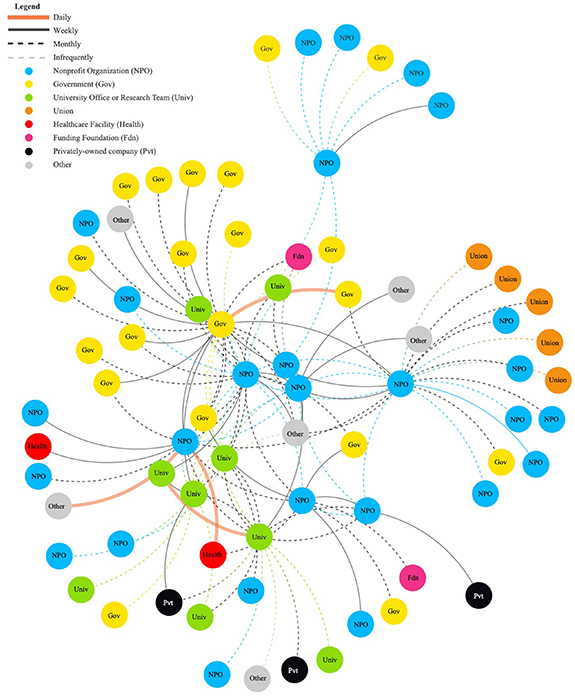
Questions remain such as how legal frameworks can be leveraged to guarantee protections against chronic heat, how to improve occupational healthcare surveillance, and which solutions are most cost-effective. Analyses such as those focused on public policy and social networks can aid in understanding key actors involved, where political will stands, and what groups are needed to create heat-related institutional and systems change. A particularly useful tool for this is network mapping. A network map can be a useful way to determine where coordination exists, how information and resources flow, and how connectivity can be strengthened to support action [116]. The map can also efficiently visualize additional layers of information such as variations in objectives, theories of change, resources, and how these dimensions overlap with connectivity. The information can be used to identify groups that are missing from the network or not as well connected to build new connections and further support existing work. Figure 6 shows an example of a network map of organizational actors working to mitigate the impact of chronic heat in Miami-Dade County. Entities have different focuses such as workers’ rights, environmental science, environmental resilience, transportation, health and healthcare, and emergency management. Many of these entities meet monthly through the Urban Heat Research Group through which individual representatives come together to discuss initiatives and research updates related to chronic heat in South Florida, allowing for real-time, iterative responsiveness across ongoing research and local actions and responses. The Miami-Dade network and Urban Heat Research Group are two examples of how chronic heat can be addressed through transdisciplinary collaborations. Heat champions and governments addressing chronic heat can look to similar examples to build their own diverse coalitions.
6. Conclusion
Chronic heat is a pervasive issue that affects billions of people globally. With climate change, places accustomed to acute heat are likely to become chronically hot as temperatures rise. Current approaches have fallen short in recognizing and addressing chronic heat risks and impacts. The proposed framework presents the following: a working definition to identify chronically hot places; the differences between chronic versus acute heat vulnerability, exposure, and risk; modifications needed for adaptive responses to address chronic heat; and a chronic heat research agenda to address longstanding gaps. Chronic heat is a complex issue but also an opportunity to address systemic inequalities and improve living standards for those most vulnerable. With continued efforts by researchers, practitioners, and government bodies, chronic heat can be better understood, managed, and treated as an urgent and dangerous hazard.
Acknowledgments
This work was carried out with support from the Leonard and Jayne Abess Center for Ecosystem Science and Policy; the University of Miami Laboratory for Integrative Knowledge (U-LINK) support for Training in Heat-Related Equity and Disparities (THREAD); and the National Oceanic and Atmospheric Administration Cooperative Institute for Marine and Atmospheric Science Grant (#NA20OAR4320472-T1-01). We thank the CLEO Institute, Zac Robertson, and Austin Bozgoz for helping us develop this framework.
Data availability statement
The data that support the findings for figures 1, 2, and 4 [117] of this study are openly available at the following URL/DOI: https://doi.org/10.6084/m9.figshare.c.7519083.v1.
Author contributions
All authors conceptualized the research and provided input to drafts. M.C., K.J.M., L.T.H., and A.C. conceptualized and visualized figures with assistance from A.F. and L.G.M. in crafting the first figure and from M.F. for the sixth figure. Authors K.C.A.-B. through J.P. are listed alphabetically having provided equal contributions to the manuscript. M.C. drafted the manuscript with major edits by K.J.M. and A.C. and review by all authors.
Conflict of interest
The authors declare no conflict of interest.
“ “
